The Houses that Haunt Us
for Profs & Pints
October 26, 2026
Fait la Force Brewing
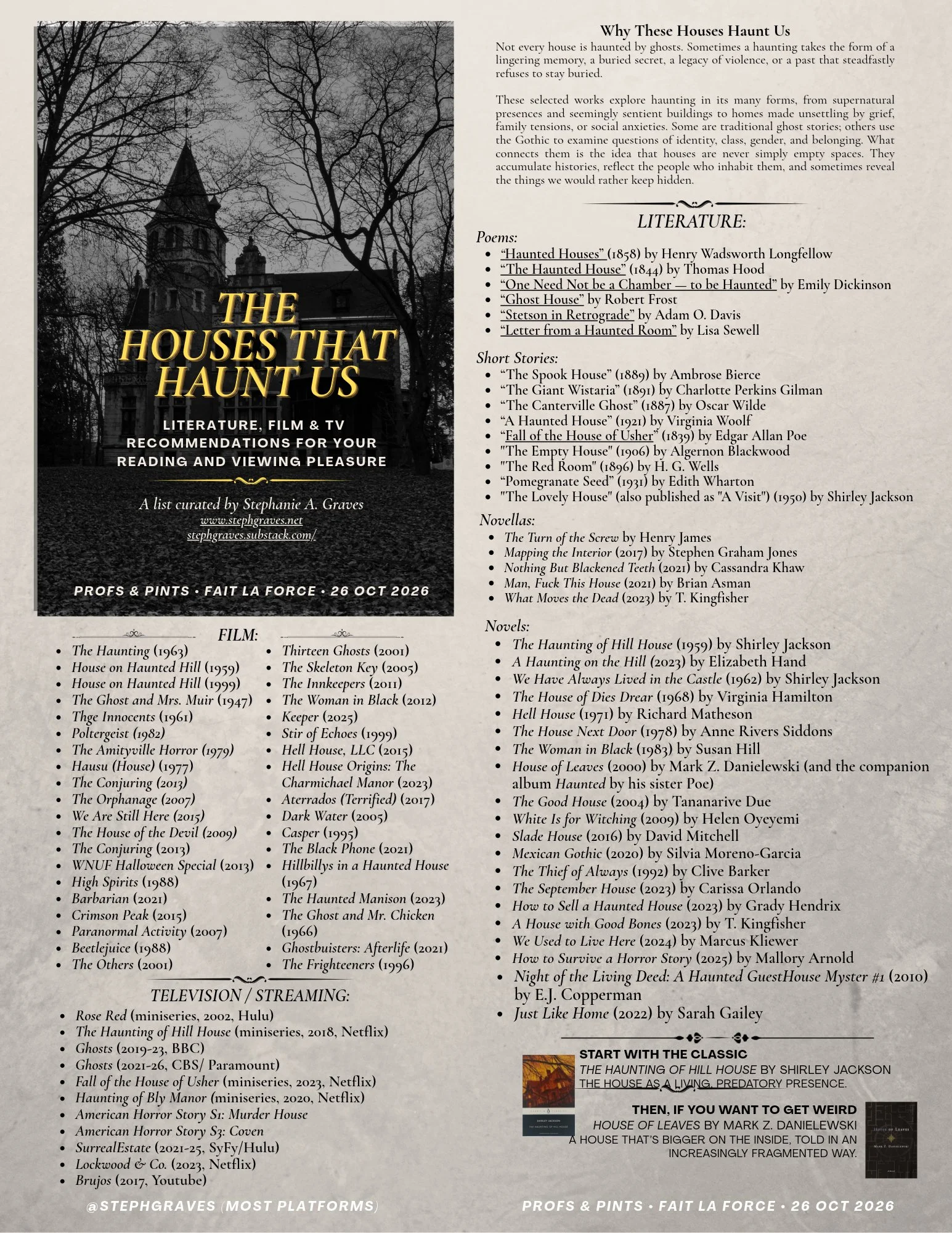
Why can houses be so frightening? Typically a location that offers safety, privacy, family, and stability, the horror genre instead transforms houses into places of danger, secrecy, entrapment, and terror. After all, a haunted house isn’t frightening because a ghost happens to live there—it’s frightening because the one place that’s supposed to protect you becomes the thing from which you need protection.
This talk explores the long literary and filmic history of the haunted house and asks why domestic spaces are so effective at unsettling us. It will trace the haunted house from Gothic castles and nineteenth-century ghost stories through works such as The Haunting of Hill House, The Amityville Horror, Poltergeist, The Shining, and The Haunted Manison, as well as more recent horror films like Barbarian and Hell House, LLC. Along the way, it will examine how the haunted house changes as ideas about family, property, class, gender, and domestic life change. Along the way, we will consider why, in its preoccupation with the past, the house that’s supposed to culturally signify safety and security is instead full of buried secrets, unresolved violence, and histories that refuse to stay hidden.
Stephanie A. Graves is an associate professor of English at Columbia State Community College in Franklin, TN where she teaches courses in writing, rhetoric, and literature. Her scholarship centers on popular culture, horror, and the Gothic and the Southern Gothic. She is the co-author of Netflix’s Chilling Adventures of Sabrina: Hell’s Under New Management, and a co-editor of the B-TV Book Series with Bloomsbury Press. Her research focuses on how horror uses familiar genres, images, and spaces to shape cultural anxieties, especially around identity, family, bodies, and the meanings attached to home.
SLIDES (links to PDF):